by Amanda Montell
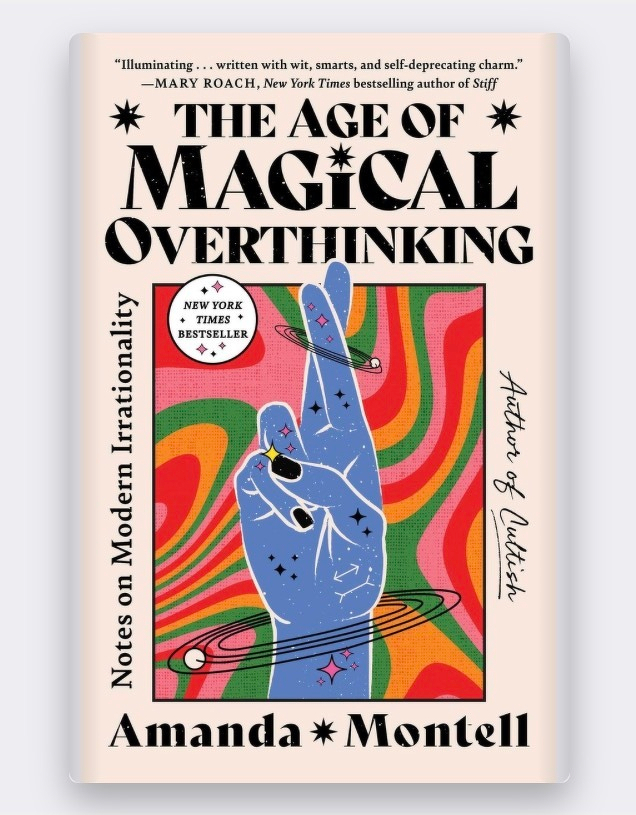
We live in an age where we can easily feel overwhelmed. An age of overconsumption that feeds overwhelmed feelings. Part of being overwhelmed is caused by some modern biases that we share as a society. This book explores some of these biases that we carry around with us — many of them without even noticing. The psychological term used is cognative biases. That is a simple (without overthinking) way of saying “self-deception.” What follows is an explanation of some of the cognitive biases plaguing modern society. This is an important work, written in an informal style with plenty of personal examples from the author’s own life.
People tend to be overly worshipful.Another attribute of this is “cancel culture.” This effect is manifested by the tendency to make overly broad assumptions about a person based on a single attribute. We see this in our hero worship. Knowing one thing does not mean a person knows everything. Assuming that they do know everything can lead people down some very dark alleys. Not a bias we should subject ourselves to.
This is the human perception that causes us to search for big causes when big events occur. This bias causes us to overestimate cause-and-effect relationships. It makes us want to look for big (and easy) solutions to problems that are actually complex. People that have trouble seeing complexity in the world around them are particularly susceptible to this effect. You may be familiar with the term “Conspiracy Theory” (who isn’t) That’s what we are talking about here. A conspiracy theory is an explanation that appears to make sense and it offers an emotionally satisfying explanation for some uncomfortable reality.
The best explanation for this bias is when you decide you can’t give something up because you have too much invested in it. Think relationships here. Also jobs, political beliefs, and so on, ad inffinitem. In the back of your mind is the idea that things can’t get any worse so they must necessarily get better. The sunk cost fallacy is a mental state that prevents us from moving forward. It prevents us from seeing the damage we are doing to ourselves. We can prevent this bias from controlling our life by acknowledging it and not dismissing it.
This bias embodies the notion someone else’s gain is our loss. This is a perfect example of one of my favorite T-Shirt sayings: “Equal rights for everyone does not mean fewer rights for you.” Life is not cake. When all the slices are gone, so is the cake. Life is a cake that never runs out of slices. Don’t be afraid to give a slice to someone else.
This is the tendency to attribute success to reasons that are not attached to reality. We tend to look outside of ourselves for reasons why we succeeded. To look for reasons greater than ourselves. A near death survivor may attribute their good fortune to “the universe willing” their destiny. This holds true in business, athletics, fine art, war, you name it. Not only do we tend to look outside of ourselves for answers, we also have a tendency to dismiss or ignore the actual reasons. You might call this optimism run rampant. It’s better to take charge of your life and recognize that it is yours and you choose what it will be.
I like to think of this as the “alien” bias. For a brief period of time in 2021 everyone thought the world was coming to an end. It was commonly held that aliens were coming to get us. It was a wide spread societal Illusion. The Recency Illusion is the bias that says since something is new to you (and note worthy) it has to be important. Anything new is more cognitively stimulating than threats that have occurred in the past, even if those threats may still be active in some capacity.
This is my favorite bias. (Not the one I exhibit most, the one I like the most.)
Don’t be like the man that covered his face in lemon juice then walked into a bank and held it up without a mask. He did this because lemon juice makes you invisible, everyone knows that right? You may think that’s just stupid, not over confident, but there is a fine line between I.Q. and confidence, sometimes they overlap in dramatic ways — like in the case of our overconfident stick-up man. Grifters, con artists, even successful CEOs all suffer overconfidence. The key is to make sure your affliction is properly channeled. There is a famous study by Cornell Psychologist David Dunning which hypothesized the “Dunning-Kruger Effect. The study demonstrated a statistical correlation between people with the smallest amount of knowledge on a subject consistently proving themselves likeliest to overvalue their expertise. Gosh, that explains a lot doesn’t its it? I can’t tell you if naming the effect after himself (and his research assistant) was overconfidence or not… but it does lead one to wonder.
Beware much repeated claims. Check your sources. With so much information available at our finger tips these days, and much of it unreliable, you can’t be too careful about what you choose to believe. Ultimately what we accept or don’t accept as truth is entirely up to us. This bias comes down to our propensity to believe a claim simply because we have heard it repeated multiple times.
Beware of people that work backwards from their strongly held beliefs to prove that some new discovery is nothing but bogus fluff — in order that they may continue to live in their long held delusion. Case in point: Dinosaurs are extinct only because God decided not to let them on the ark — therefore they became extinct 2,000 years ago, not 2 million years as fossil remains have proven. We have a tendency as humans to look for reasons, as impossible as they may be simply to confirm beliefs we have difficulty abandoning.
Declinism is the false notion that things are worse now than they were in the past. It is difficult to find studies that validate that hypothesis, yet when we look around and talk to people we see many people expressing this notion. The empirical evidence is everywhere. As ancillary evidence, the number of people that report being happily married is almost the same as it was in the 1950’s when this question first started being asked. Other psychology research verifies that people hold on to positive memories with greater emphasis than they do negative memories. This naturally leads to a stronger connection to the pas than if both types of memories carried equal weight in our consciousness. Hence the tendency to glorify the past and decry the present.
We all tend to ascribe a higher value to things that we have made ourselves the to things that we have purchased. It’s why IKEA is such a successful retailer of home furnishings. It’s why I sit at my desk and design the perfect side-table in my head, planning to make one someday. (I actually have four different designs in my head.) “DIY, Reduce, Reuse, Recycle, Pinterest, The Cooking Channel, how-to Reels on Instagram, all are reflections of this increasing trend. In one very interesting study by the Bureau of Labor Statistics, the highest levels of career happiness was reported by loggers. These are people that work with their hands in the outdoors. The answer is clear, go build something!
I also enjoy the reflection that is part of the journey.